Jesus the bread of life in John 6
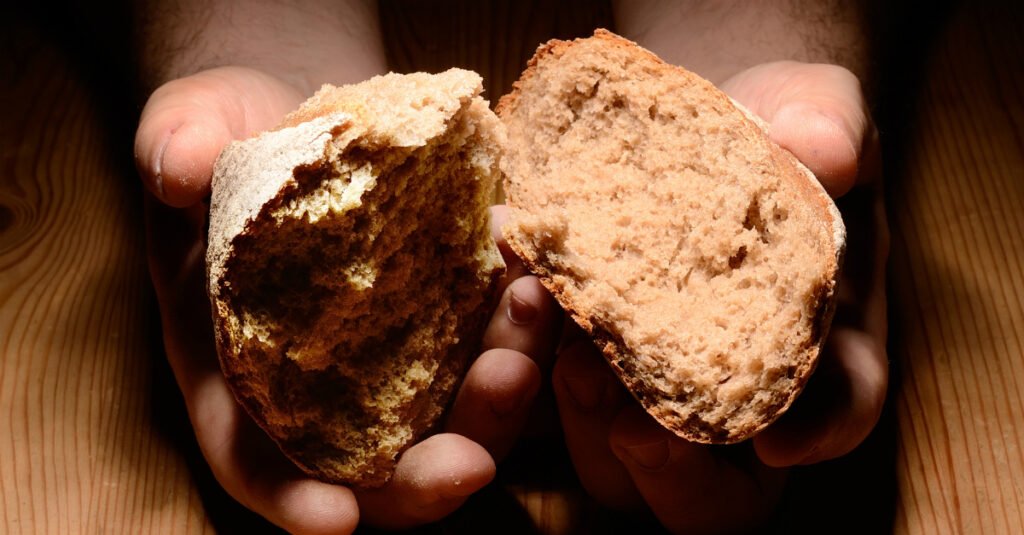
We go on through our careful reading of John half dozen equally an intermission from Marking'southward gospel, and on Trinity ix in Twelvemonth B the gospel reading is John six.24–35. Having romped through 21 verses last week, which include the Fourth Gospel'southward lengthier version of the feeding of the 5,000and Jesus walking on h2o (though in a brief summary), we are slowing downwardly to consider the first eleven verses of the 'bread of life' dialogue that, uniquely, follows the feeding in this gospel.
For some reason, the lectionary omits the connective verses John half-dozen.22–23. They begin with a feature temporal marker τῇ ἐπαύριον 'on the adjacent day', which Matthew and Mark but employ in one case each, but the Fourth Gospel uses particularly in chapter 1 to count through the starting time seven symbolic days of Jesus' early ministry. (The work does not occur anywhere in Luke, but frequently in Acts as information technology tracks the activities of the Peter and Paul.)
These omitted verses as well give some careful geographical detail, over again feature of this gospel, which would have been incommunicable to include past someone non familiar with the region on first-mitt terms (see the section on topography from p 95 inThe Testimony of the Honey Disciple by Richard Bauckham). The repeated references to 'the other side' (John 6.22, 25) refer to the northward-eastern and north-western shores, rather than suggesting anyone has crossed the centre of the lake, and besides as pointing to topography also presume that we take read Marking's account of these events.
In the synoptics gospels, Jesus is portrayed as dynamic and active, travelling effectually and actively seeking out 'the lost', especially in the first half of his ministry, in Galilee ('The Son of Man has come up to seek and salve the lost', Luke 19.x). By contrast, in the Fourth Gospel Jesus doesn't seek people out, merely remains a centre of stillness, and at times even elusive ('You will seek me merely you lot volition non find me' John 7.34), as others seek him.
This question—"Whom do you seek?"—runs through the Gospel of John like a light carmine thread…The thread started running with the very first words Jesus spoke in this Gospel, which formed a question directed at the disciples of John the Baptist that started to follow after him. To them, Jesus said, "What do yous seek?" (ane:38). When Jesus utters an even more personal class of this question to Mary Magdalene, it is not the second but rather the third time this basic question has appeared. In between the first and the last is the question of Jesus not to his would-be disciples, not to this first witness of his Resurrection, only to the ring of soldiers his betrayer has gathered. To them, likewise, he asks, "Whom do you seek?" (18:4).
When they find him, in that location is no proffer that they idea he had arrived there miraculously. Just equally only a few were aware of how the water became wine in John 2, so simply the 'insiders' knew he had walked on the water.
Jesus is addressed as 'Rabbi' (literally, 'my great one' in Hebrew) seven times in this gospel (John 1.38, 49, iii.ii, iv.31, here in John 6.25, ix.2 and 11.eight), and additionally John the Baptist is given this title in John three.26. It functions as a championship of respectively address, often in the context of those using it not understanding what Jesus is doing or what is happening; in that location is no proposition that information technology was a formal championship implying training and recognition; Jesus is non a member of the scribal elite. On the first occasion of its use, the writer explains its meaning (John 1.38), reminding us that this gospel is both rooted in a particular cultural, geographical and linguistic context and that this needs translating for a different and wider world. Translation is always central to the task of missional proclamation.
Once once again, the enigmatic Jesus of the Fourth Gospel refuses to requite an answer to a directly question. Instead, he responds with one of his 'Amen, amen…' sayings which pepper this gospel 25 times. The atypical grade 'Amen I say to y'all…' occurs frequently in Matthew, ofttimes in Marking and occasionally in Luke; like other uses of Aramaic terms in the gospels, it suggests an business relationship of theipsissima verba,the actual words of Jesus in Aramaic (alongside 'Talitha cumi' in Mark five.41, Jesus' address of God equally 'Abba', and his cry from the cross 'Eloi, eloi, lama sabachthani' in Matt 27.45). The Fourth Gospel doubles the term, and it is impossible to know whether this is a true-blue business relationship of Jesus' actual use which has been simplified elsewhere, or a drawing out of Jesus' business organisation for truth which forms a key theme in this gospel.
It might be rather surprising that Jesus uses this stern introduction to what appears to be a mundane saying, essentially, 'You lot have not yet understood the meaning of the feeding of the 5,000'. Only in this gospel, at that place is a repeated contrast between the mundane and the spiritual, expressed almost frequently in the double meanings of so many words and sayings. Light, night, seeing, bread, nighttime—all these have a symbolic significance pointing to spiritual reality, and the crucial partition in the narrative is between those who can see it and those who cannot. Although the crowdssaw that Jesus provided bread and fish, they did notmeet this as a sign pointing to who Jesus actually was. The theme of seeing and not seeing will be picked upwardly and developed in detail in chapter 9, the healing of the human being built-in blind.
The contrast between the mundane and the eternal is expressed past Jesus in the dissimilarity between the 'nutrient that perishes' with the 'nutrient that abides to eternal life'. These terms are loaded with significance; in John iii.16 those who believe in God'due south but son practice not 'perish', and whoever wants to alive must 'bide' in the true vine in John fifteen.4. In this sense, you lot are what you eat: eat food that perishes, and you will perish; eat food that abides to eternal life, and you will have eternal life.
Jesus uses the term 'piece of work' as a metaphor for seeking or striving, and, again feature of this gospel, the next response of the people doesn't follow on logical from Jesus comment and so much every bit hangs on the repetition of a particular term, 'What must nosotros practise to be doing theworks of God?' Since eating food is closely connected with believe in the but Son of God, information technology is not surprising that Jesus transforms the language of 'work' in the language of 'conventionalities'. There is here a quite strong connection with Pauline theology; equally John Ziesler has commented (Pauline Christianity) for Paul faith is not a 'thing', but only an acceptance and receiving of what God has offered, not in whatever sense something nosotros 'do'.
The title 'Son of Man' occurs 13 times in this gospel in 12 verses. Information technology ultimately derives from the vision of Daniel 7, when a figure 'like a son of man' is lifted up to the throne of God and given an everlasting kingdom. Information technology begins its life as a Hebrew and Aramaic idiom for a vulnerable human effigy, and signifies personified Israel. Just the term has now taken on a life of its own (whilst non leaving this origin behind) and is used past Jesus in the gospels both to signify his own vulnerable humanity ('they volition hand over the Son of Human to be crucified…') merely as well to claim he is the true Israel, who after suffering will be exalted to the throne of God in the Ascension. The Fourth Gospel again appears to assume that we will be familiar with this term from its frequent use in the Synoptics. Simply within this gospel it is associated with access to God'due south heavenly presence (in John 1.51 and John 3.13, 14), Jesus being glorified and lifted upward, but paradoxically by his crucifixion (John viii.28, 12.23, 34, John thirteen.31) and bringing life to others by his decease (John 6.53).
The thought of Jesus being 'sealed' by God is slightly unusual, though it has already occurred in a metaphorical sense in John iii.33. The NIV and other ETs interpret the meaning as 'a seal of approving', suggesting God's affidavit of Jesus. 'The term is found in commercial documents among the papyrus where it denotes the sealing of messages and sacks to guarantee that no-i tampers with the contents' (Kruse, TNTC, p 134). Information technology is clearly used in this sense (both literally and figuratively) in Matt 27.66, two Cor 1.22, Eph iv.thirty, Rev 20.three and (negatively) in Rev 22.10. But it is difficult to completely separate this from the language of sealing in Eph ane.13 and Rev 7.3, where there seems to exist a broader sense, and the linguistic communication of Jesus equally the 'image' of God, who reflects the nature of his character ('Whoever has seen me has seen the Father', John 14.nine).
It seems odd, in narrative terms, that his interlocutors then inquire for a sign—given that Jesus has just fed v,000 people! This fits within the 4th Gospel as pointing to the obtuse nature of 'the Jews' (often meaning those who refuse to believe in him, or those Judeans in the south, or the leaders of the people) who will not recognise the miracles/signs that Jesus does, and will non believe the claims Jesus makes. But it also fits with the dynamic in the synoptics where the people 'demand a sign' which Jesus refuses to requite (Matt 12.39). Over again, the repetition of the term 'work' for such a sign links this comment with the previous commutation on both sides.
There is no surprise with the link to the Mosaic episode of manna in the wilderness. As we noted last week, connections with Moses and the wilderness abound: Jesus has gone upwardly on a mount; the people are gathered in a desert identify (according to the parallel we take read in Mark); there is a demand for feeding, and no obvious way to provide; and Jesus is recognised as a 'prophet similar Moses'.
The quotation from the Scriptures ('As it is written…') appears to exist a paraphrase of a combination of Ex 16.4, 15 and Ps 78.24. The language of 'food' (βρῶσις) has now been replaced with the term 'breadstuff' (ἄρτος), demonstrating (contrary to our assumption) their equivalence. This is confirmed by the description of 'manna' (which originally simply meant 'What is this?'—manna is literally 'What do you telephone call it') as 'bread', which is clearly isn't, unless staff of life is a broad reference to food in general.
Andrew Wilson highlights the way we need to translated the thought of Jesus as bread from the first century into our civilisation.
In some means the biblical give-and-take bread corresponds more than closely to our concept of nutrient than our concept of staff of life. It was not just an important function of a repast, or even the virtually popular 1, only the essence of all meals. Bread was life.
When a waiter asks if we would like a fleck of staff of life for the table, nosotros might say no, seeing it equally an appetiser before the real food comes out, and so we read that sort of take-information technology-or-exit-information technology arroyo into our Bibles. In the biblical globe, on the other hand, bread is essential. It is life-giving, and without it you lot starve…
When Jesus says "I am the bread of life" it is not an appeal to taste. Jesus is non saying that he is a savoury appetiser or a side dish or a pop choice amongst people who similar their spirituality nutritional and fresh from the oven. He is claiming to be essential, life-giving, one upon whom human beings are entirely dependent and without whom we cannot function properly. (God of All Things, pp 142–144).
Jesus' emphatic response ('Amen, Amen…' again) is to make ii shifts. Commencement, Moses was not thesource of this 'breadstuff', but simply the ways by which God provided information technology, and God himself is the origin. Secondly, the bread that God volition now give is 'the one' (contra NIV, 'the breadstuff') that comes down from heaven. This echoes the linguistic communication of John 1; the light has come into the earth in the class of the word who has get flesh, and he brings life to the whole world. This staff of life will non just feed the people of Israel, but all who will receive him.
Every bit in previous episodes (and ones that follow) in the dialogue Jesus sets upwards an expectation which his interlocutors then desire to fulfilled—to which Jesus replies that he is the answer. Compare John 4.15 'Sir, give me this water' with John 6.34 'Sir, give usa this bread' and John 9.36 'Who is he, sir, that I may believe in him?' Jesus himself becomes the climactic answer to the heightened question that has been given urgency past the tantalising promise of God that the hearers long to be fulfilled.
We can see, now, why Jesus is addressed equally 'Rabbi', teacher. We practise not live past bread solitary, but by the very word that comes from God; Jesus is the discussion of God who has come down; therefore it is Jesus, in both his person and his teaching, who is the staff of life of life with which God feeds us.
In the Fourth Gospel, there are seven occasions where Jesus declares simply 'I am', without adding a predicate, and vii occasions where Jesus declares 'I am [something]', with a predicate, of which this is the last. Felix Merely notes how all these images are rooted in the OT, and primarily refer to God's human relationship with State of israel:
- Staff of life of Life / Staff of life from Heaven – see Exod 16; Num 11:6-9; Ps 78:24; Isa 55:1-3; Neh 9:15; 2 Mac 2:5-8
- Light of the World – Exod thirteen:21-22; Isa 42:half dozen-7; Ps 97:iv
- Good Shepherd – Ezek 34:one-41; Gen 48:fifteen; 49:24; Ps 23:1-4; 80:ane; 100:3-four; Micah 7:14
- Resurrection / Life – Dan 12:ii; Ps 56:13; ii Mac 7:i-38
- Way – Exod 33:thirteen; Ps 25:4; 27:11; 86:11; 119:59; Isa 40:iii; 62:10
- Truth – one Kings 17:iv; Ps 25:5; 43:iii; 86:xi; 119:160; Isa 45:xix
- Vine / Vineyard – Isa 5:one-7; Ps eighty:8-17; Jer 2:21; Ezek 17:5-ten
The general nature of breadstuff as food and sustenance is once again emphasised by Jesus' apply of parallelism: 'who comes to me/shall not hunger/who believes in me/shall never thirst', the latter of which connects united states of america back to the woman at the well in affiliate iv. Information technology also makes clear what began this dialogue: that 'feeding' on Jesus is primarily a metaphor for believing in and trusting him. If and when we eat bread and potable wine as a sign of this, it is a sign of our receiving him, of 'feeding on him in our hearts, past faith, with thanksgiving'.
If you enjoyed this, exercise share it on social media (Facebook or Twitter) using the buttons on the left. Follow me on Twitter @psephizo. Like my page on Facebook.
Much of my work is done on a freelance basis. If you have valued this post, you can brand a unmarried or repeat donation through PayPal:
Comments policy: Good comments that engage with the content of the postal service, and share in respectful debate, can add together existent value. Seek first to understand, then to be understood. Brand the most charitable construal of the views of others and seek to learn from their perspectives. Don't view contend as a disharmonize to win; accost the argument rather than tackling the person.
darbyhipturre1956.blogspot.com
Source: https://www.psephizo.com/biblical-studies/jesus-the-bread-of-life-in-john-6/
0 Response to "Jesus the bread of life in John 6"
Enregistrer un commentaire